
Many of you know, the framework started as I left a lot of the spiritual world behind, but that doesn’t mean I gave it all up.
I kept my beliefs about the spirit world pre and post human form. I still believe we’re spirits in meat suits and that the human body acts as a car for the spirit to drive around in. I still believe in past lives, talking to ghosts or spirits, and even channeling. I still practice tarot every day.
The hard line I drew with spirituality was in how it was used to interpret daily life. That was the part that didn’t make sense. It left trauma out. It didn’t fully explain why experience happened or how things were the way they were. Some of it was just fluffy, poetic language that didn’t really say anything at all. That’s what led me to build the framework.
Here are a few places where the language of spirituality and the language of the framework are pointing to the same thing.
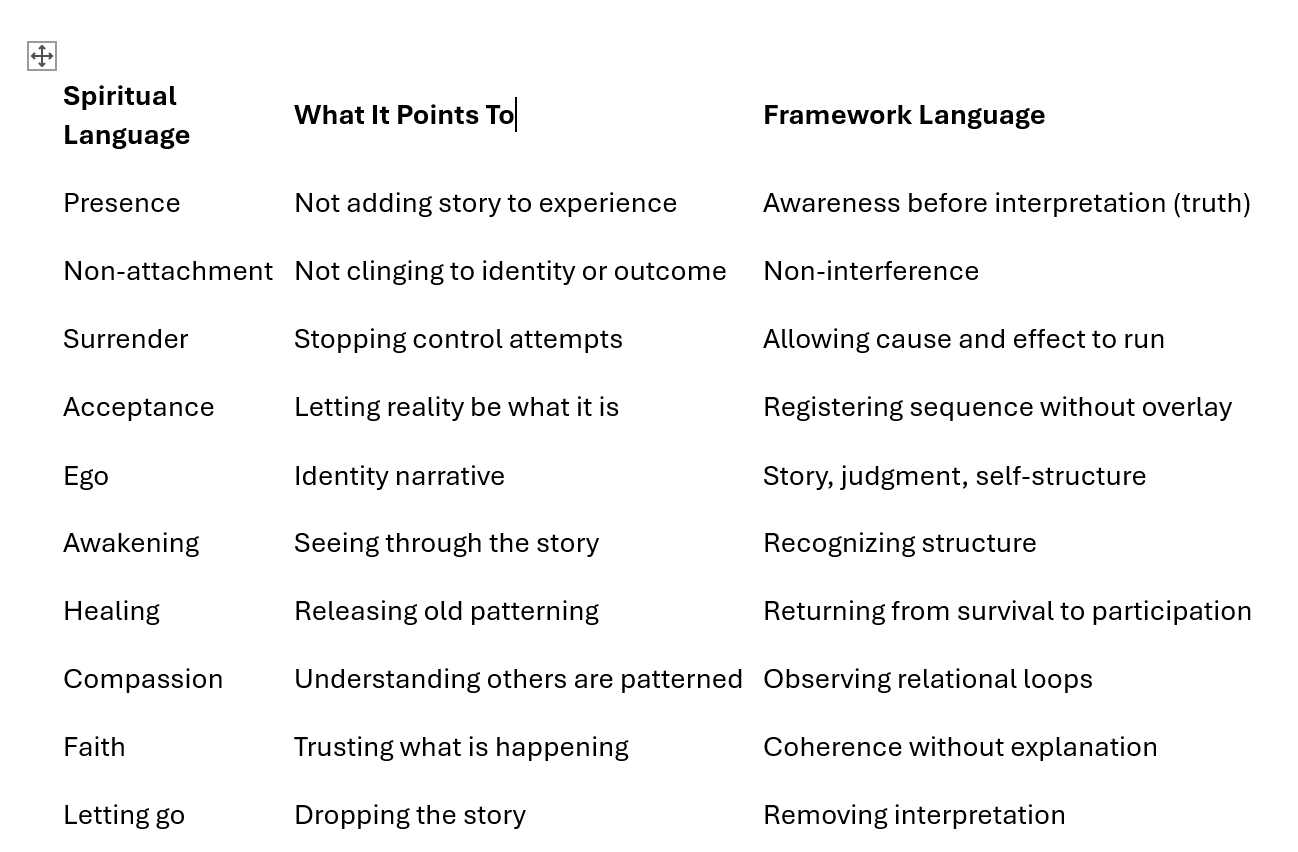
Spirituality often uses phrases like raise your vibration, heal your inner child, align with your higher self, or manifest what you desire. The difficulty is not that these are false. The difficulty is that they are imprecise. They are attempts to describe something structural without having the structural language to do it.
What they are pointing to is this:
You are adding story to sequence.
You are trying to control cause and effect.
You are still operating inside identity.
You are mistaking interpretation for truth.
“Manifesting” is a good example. It can sound as though the universe is a kind of slot machine that responds to hope, prayer, or positive thinking. What is actually happening is much simpler and much less mystical.
You stop interfering. You allow the causal chain to complete. You participate in reality in a way that aligns with how things actually unfold, and the next logical outcome appears.
If that outcome is what you wanted, it can feel like you created it through intention or belief. In reality, you worked with cause and effect instead of trying to control it.
The mysticism that spirituality often places over everyday experience exists because people do not have a clear explanation for why things happen the way they do. It is easier to say that some things are beyond human understanding than to admit we do not yet have the language to describe them. Simply saying “people are in pain” wasn’t enough.
For me, this was the point where spirituality stopped answering my questions. Many religions frame experience as a struggle between God and the Devil. Many spiritual traditions explain confusion by saying our perception is limited and that some things are simply not ours to understand.
I could not accept that. I felt there had to be a reason experience unfolded the way it did, without needing to understand each individual point of pain and suffering. The framework is my attempt to describe that reason in a very clear, logical way.
If I could sum up the framework in one clear line it would be this:
You do not need to understand every point of pain and suffering to understand experience. You only need to understand how cause and effect move through individual structures and across non-local chains to produce what unfolds.
If a person’s causal structure is arranged such that what they did is the next logical thing for them, then behaviour has an explanation that does not require psychology or a deep personal history. The experience can be explained independent of human story logic and rules.
The difficulty, of course, is accepting that what happened was coherent within that structure. Most attempts to explain experience step around this point.
Two things can be true at the same time. An experience can be coherent in its structure and still be horrific from a human perspective. The challenge is learning to separate the human perspective from the experience itself. When those two remain distinct, the experience can be seen clearly without narration layered on top.
This is where spirituality often struggled to explain experience. It treated the human perspective and the human rules as part of the truth of what happened, when they are not. The story we tell about the event and the rules we want to apply to it are not the event. They are commentary and human belief.
People often act from within that commentary and those rules, and those actions become part of the causal chain. The chain itself, however, is indifferent to the story and the human rules. It responds only to what is done, not to what is believed.
By looking directly at the causal chain, we can understand the experience without needing to untangle the commentary or perceived rules that helped shape the action.
Spirituality gave me the power to start asking questions. It showed me that my interpretation was under my control. It helped me put my personal power back in my body after years of insecurity. It offered me a pathway to writing the framework.
Spirituality is a very useful tool to help shift your perspective, feel better, and take some control over your own life. What spirituality could not do was answer my desire to understand why things were happening without outsourcing it onto a higher power. The framework gave me a way to interpret experience without needing to tell a story about it.
If you’re interested in moving beyond spiritual explanations or gaining further clarity, I invite you to check out my book shop, where I offer a number of tools and resources to help you understand your experience through the framework, not as self-help, but as logical explanations for why life is the way it is.
Love to all.
Della